Tools & Home Improvement / PRODUCT GUIDE
Craftsman CMHT77633 guide: a simple edge finder that asks you to mark both sides
The CMHT77633 is a basic electronic stud-edge detector for suitable drywall jobs. Its value depends on being comfortable with calibration and two separate edge marks, rather than expecting a screen to draw the full stud width for you.
As an Amazon Associate I earn from qualifying purchases.
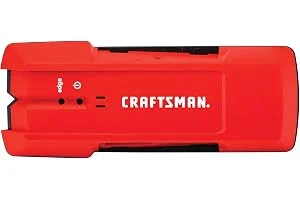
View CRAFTSMAN Stud Finder, 3/4-Inch Depth (CMHT77633) on Amazon (paid link) ↗
Buy it for the edge-finding method
Craftsman lists detection of wood and metal stud edges through up to three-quarter-inch drywall. This is the Hi-Vis Stud Sensor, not the brand’s laser-level combination or its deeper center-finding models. The distinction matters because broad brand descriptions can mention features that belong to different products. Match CMHT77633 and ASIN B07QJD6VLL before comparing prices. It is an option for someone who wants a straightforward indication during an occasional mounting project and is happy to complete the layout with pencil marks and a separate level.
Budget for a calibration step on every scan
The official manual uses a 9-volt battery. Hold the tool flat against the surface, press and hold the button, and wait for the red light to go out before moving it. Calibration directly over a stud or dense material can fail; move to another position if the red light stays on. That starting step is a practical difference from the Franklin alternatives below. If repeatedly restarting a scan sounds frustrating, the more informative display and different startup method of those tools may be worth considering.
Turn two edge marks into a usable layout
When the red indicator and tone signal an edge, use the top notch to mark it. Repeat from the opposite direction; the midpoint between the two marks indicates the center. Before buying, think about whether there is room to make those passes around the proposed mounting location. This method is easier to understand when you plan the measurements before holding a bracket against the wall. Keep the bracket’s hole pattern separate from your scan marks so you can see whether the installation instructions and the available positions agree.
Know the limits before relying on a mark
The manual warns that nearby pipes and wiring can be mistaken for studs. This model is not presented here as a live-wire detector or a clearance scanner. Its markings do not establish a safe drilling point, and the three-quarter-inch range is not a universal promise through layered or unusual wall finishes. Resolve uncertain construction before penetrating a surface and follow the installation requirements for the item being mounted. Ryan has not checked its accuracy against exposed framing; there is no measured success rate or guaranteed mounting result behind this recommendation.
Compare Franklin M150 if you want to see the detected width
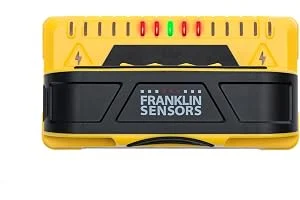
The M150 B0917TH83L uses a row of 15 LEDs and nine sensors, with a stated 1.5-inch depth and an electrical warning. It is the more relevant step up when the Craftsman’s two-edge workflow is the part you want to avoid. The extra information can help you observe a region as you move, but it still requires interpretation. For a single uncomplicated task, decide whether that convenience justifies the current price difference. For repeated work, reducing the amount of edge-marking may matter more than buying the least elaborate tool.
Compare Franklin M210 for a fuller layout toolkit
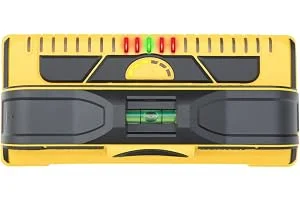
The M210 B0917VXLDK offers a 21-LED display, 13 sensors, a bubble level and pencil storage. Those additions make a stronger case when wall layout is a recurring activity, rather than a tool you expect to use once and put away. The Craftsman keeps the purchase focused on edge finding, leaving alignment and marking to tools you already have. Choose based on how you prefer to work and the documented surface limits. Buying the M210 for its added convenience should not be confused with obtaining a tool that can certify everything behind a wall.
Compare the shopping options
Franklin M150 — full-width LED indication and wire warning
Franklin M210 — wider display and integrated layout aids
Sources and review basis
Researched November 20, 2026. Ryan’s own experience is attributed where supplied. Other judgments are buying advice based on the cited product information, not a hands-on comparison or laboratory test. Prices and availability are checked at the retailer.